
By HitLytics · Updated November 19, 2026 · Editorial and evidence standards
Start with the source, not the final volume knob
If you hear distortion and the master has near-full-scale warnings, inspect the loudest flagged passage in the original session. Check the source recording, channel processing, buses, limiter and export in that order. Repair the earliest damaged stage you can, export a new file, then compare the same passage at matched playback level.
If the only evidence is a near-full-scale count, listen before deciding what to change. A decoded sample near full scale is a warning proxy; it is not proof of audible clipping. The free scan gives a technical next step, not a verdict on the song or its commercial potential.
What the clipping-related flag actually measures
HitLytics groups contiguous decoded sample frames at or above 0.999 absolute amplitude into near-full-scale events. The detailed report can show where those events occur. This threshold can flag samples close to the digital ceiling; codec overshoot can also affect decoded samples.
A sample peak is different from a reconstructed true peak. A file with no near-full-scale events may still have distortion from an earlier processing stage, and a lossy encode can behave differently from the original master. Use a suitable true-peak meter for reconstructed peak checks. Read sample peak versus true peak before treating a clean sample-peak result as a complete delivery check.
Why turning the finished file down may not repair clipping
We constructed a one-second mono signal and ran it through the production detail engine. The base is a 440 Hz sine at half full-scale amplitude. We then replaced two 80-frame regions with +1 and −1 plateaus. Finally, we multiplied that altered waveform by 0.5.
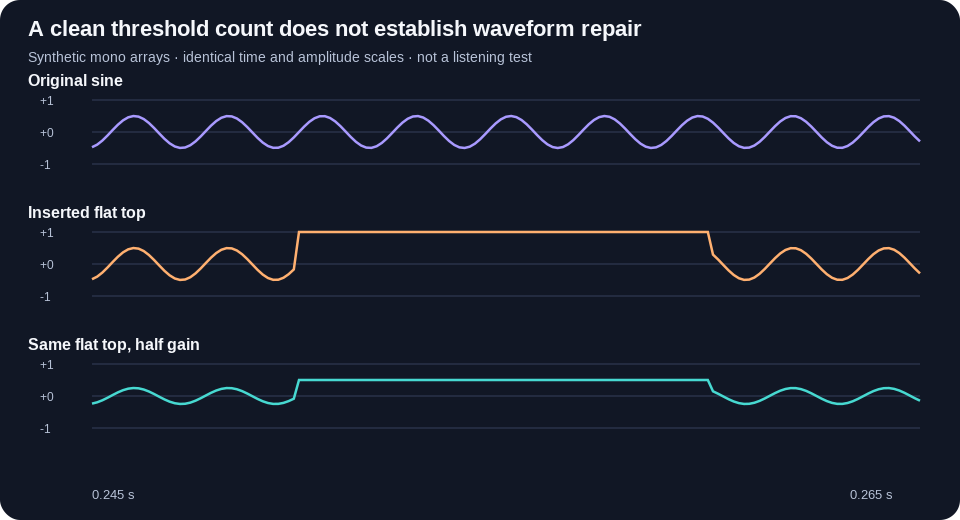
| Signal | Sample peak | Near-full-scale events | Qualifying frames |
|---|---|---|---|
| Original sine | −6.02 dBFS | 0 | 0 |
| Inserted flat tops | 0.00 dBFS | 2 | 160 |
| Same flat tops at half gain | −6.02 dBFS | 0 | 0 |
The last signal passes this particular threshold check, but its altered shape remains. That is why “zero clipping flags” is not equivalent to “undamaged audio.” The test illustrates a measurement limit; it does not establish whether any particular song sounds distorted.
These are synthetic arrays, not real songs, uploads or listening tests. Production HitLyticsAudioDetail.measure was run in Node at 8 kHz. No browser decoding, true-peak measurement or perceptual judgment was tested. Inspect the construction, threshold and complete numerical results. The package includes the reproducible generator.
Hear why turning down is not waveform repair
Synthetic 440 Hz test tones, not customer recordings. Two-second, 48 kHz, stereo PCM examples. Start with low device volume. Playback is reduced by about 22 dB and never starts automatically. These examples illustrate measurements; they do not assess the quality or commercial potential of a song.
Choose an example. No audio plays until you press a play button.
The quieter clipped waveform retains the flat tops even though its near-full-scale count falls to zero. The clean and quieter clipped examples have similar peaks but different RMS levels; this is a waveform demonstration, not a matched-loudness preference test.
| Signal | Sample peak | RMS | Near-full-scale frames |
|---|---|---|---|
| clean | -6.02 dBFS | -9.03 dBFS | 0 |
| clipped | -0.00 dBFS | -1.41 dBFS | 54880 |
| attenuated clipped | -6.02 dBFS | -7.43 dBFS | 0 |
Download eight WAV examples, results and generator (ZIP)Inspect exact measurements and construction
Free CC0 synthetic resources for artists and educators. Downloaded WAV files retain their original level; lower your playback volume before opening them. RMS is not LUFS. The player uses a short gain ramp; WAV files have no fade. JavaScript is required only for inline playback.
Find the earliest damaged stage
- Source recording: solo the relevant take. If distortion is already printed there, a later gain reduction will preserve it. Consider another take, an earlier clean file, or a clearly assessed restoration attempt.
- Track and bus processing: bypass suspected processors one at a time. Match playback level as closely as practical; a quieter version can sound less aggressive without actually being cleaner.
- Limiter and master chain: compare the passage with a controlled reduction in input drive or a different setting. Keep the artistic effect in mind: intentional saturation and an unintended overload require different decisions.
- Export: check the actual rendered file, not only the session meter. Confirm the intended sample rate, bit depth and version. Compare the delivery encode too when the destination or workflow requires it.
There is no universal gain reduction that fixes every recording. The required change depends on the stage causing the issue. Avoid adding arbitrary EQ or compression just to improve a technical number.
Verify one revision fairly
Keep the original master. Change one relevant stage, label the new version, and scan the new file. Review whether the original warning reduced and whether another problem appeared. Then compare the same musical passage at matched playback loudness.
Listen for the vocal, transients and low-end behavior on your target playback systems. Use a mono check when relevant. A stronger technical result should support the intended sound; it should not become a reason to remove character blindly.
If the flag disappeared only because the finished file was attenuated, record that explicitly. Do not describe the underlying waveform as repaired unless the source/process revision supports that conclusion.
Choose RELEASE, REVISE or TEST
- REVISE: a consequential technical warning or confirmed unintended distortion still needs a targeted fix. After changing it, check a new export.
- TEST: the measurement raises a question that listening must resolve, or the available evidence does not establish which version is preferable.
- RELEASE: the technical gate passes within the tool’s scope. Complete your listening and delivery checks; this is not a songwriting, audience or commercial-success prediction.
The engine uses the complete measured report, not this one count alone. Read how the full decision and top fixes fit together.
Check your actual master privately →